Sunday, September 18, 2011

Aanjar & Baalbeck

While in Beirut I took a day trip to the Bekaa Valley. The Bekaa is best known for being the headquarters of Hezbollah and cannabis farming, but it's also full of interesting historical sites. My first stop was Aanjar where you can explore the ruins of an Umayyad city. The Umayyads were the first hereditary dynasty of Islam and ruled from 660-750 AD. The population of Aanjar is predominanty Aremenian. The town was founded by Armenian refugees who fled Turkey during the 1915 genocide.


After exploring the ruins in Aanjar I headed to Baalbek. The town is the administrative headquarters for Hezbollah. While there are Hezbollah flags flying, there are certainly no masked militia men. I was offered a souviner Hezbollah t-shirt. While that would be just about the best souviner ever, I didn't buy it because I figured it could mess up my security clearance when I apply with the State Department. The site was originally Phoenician and was settled in the 3rd millennium BC. In 64 BC the site was made part of the Roman Empire and it became a large city. The ruins are extensive and extremely well preserved. Incredibly impressive considering the age of the ruins and the number of wars that have happened in the area.


After Baalbeck our tour group went to Zahle for lunch. Zahle is the largest Christian (Catholic) city in Lebanon. We ate at a beautiful restaurant set back in a gorge. The majority of the restaurant is outdoors with tables mixed among gardens and fountains. The Birdawni River also runs through the middle of the restaurant. We had a delicious Lebanese lunch and headed to our last stop- the Ksara Winery. I won't say much about it because the wine wasn't very good. What makes the winery interesting is that their wine is stored in caves that have the perfect temperature and humidity for storage.

Beirut

I recently had a break from school and had the opportunity to do some traveling in the region. My first stop was Beirut. Beirut is a lovely city and very un-Middle Eastern. I would describe it as a mixture of western Europe and Miami. They've done an impressive job of re-building the city after the civil war, but there are still signs of the war- some of them left intentionally so that the people won't forget what happened.


I spent most of my time walking around the city and eating at great restaurants. The city is fairly easy to get around by foot, with the exception of the fact that they don't have street signs. Beirut drivers are also quite frightening. The city has created the illusion of being pedestrian friendly with sidewalks and walk signs (unlike Amman). I learned fairly quickly that red lights mean nothing to drivers in Beirut. Not just the occasional running as the light changes; the light could have been red for a minute and people will still run it. Needless to say, I had some near-death experiences until I figured this out. I would very much prefer that they remove the walk signs so that pedestrians know that they never have the right-of-way.

Beirut lies on the Mediterranean Sea and has a beautiful pederstrian promanade. Walking along the promonade is a great way to see a wide cross-section of Beirut society. Lebanese women showing off their newly purchased breasts, men laying out on the rocks along the coast, college students, and traditional Muslim families. Beirut was not a good place for me to practice my Arabic. I heard more English and French than Arabic while I was there.


Friday, July 29, 2011

The Dead Sea & Petra

I apologize for my lack of blogging but life is quite boring when you’re in an intensive language program. I have managed to take two trips over the past few weeks.

The first trip was to the Dead Sea- the lowest place on earth. As we all know, you can float in the Dead Sea because of the high salinity. What you may not know is that your skin will not wrinkle in the Dead Sea- it’s quite amazing. Other than that, there’s not much to say about our trip. It’s relaxing, salty, and hot. We stayed at a nice resort and had a lovely time.


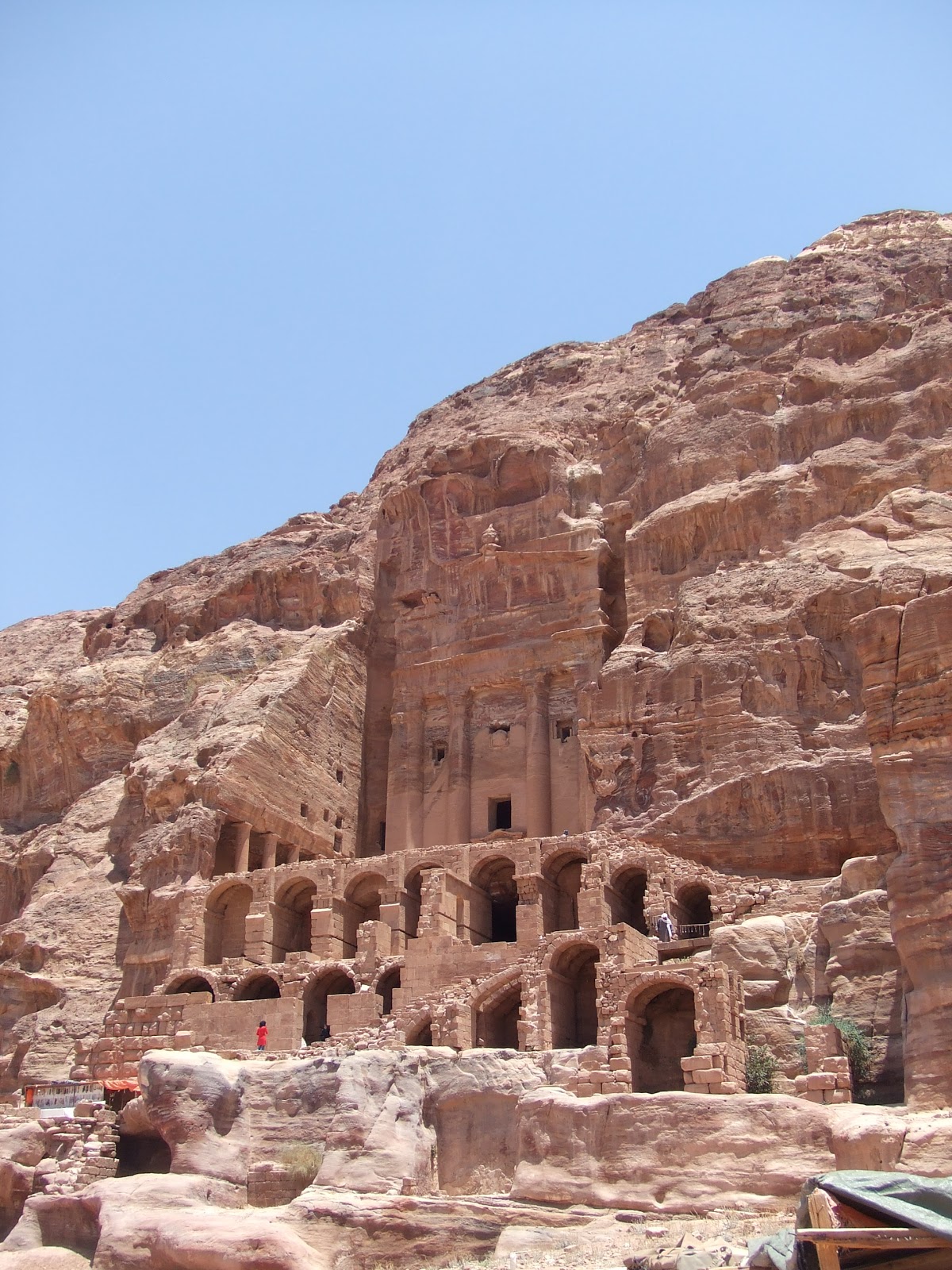
Our second trip was to Petra. Petra is one of the New Wonders of the World and it’s absolutely beautiful. It is a massive city built by the Nabataeans more than 2000 years ago. To enter the city you walk through a narrow canyon with huge rock walls.
What truly adds to the experience is the strange encounters with Bedouins. Sexual harassment is notorious in the Middle East but Jordan has fewer problems than most countries. In Amman we just get a lot of stares and the occasional comment. The harassment in the desert is significantly increased. Men will follow you, make overtly sexual comments, and offer free services in exchange for sex. We even heard some extremely obscene comments from young children- it was quite disturbing.

A lot of movies have been filmed at Petra so you might recognize it from Indiana Jones, Arabian Nights, or Transformers.

The Treasury


On a another note- I’ve decided to stay in Jordan until December. As I’m sure you can imagine, Arabic is extremely difficult so I’m going to increase my proficiency by staying another semester (Insha’Allah- God willing).

Sunday, July 3, 2011

Ajloun Castle & Amman

Here’s a recap of a couple trips we’ve taken. Our first week here the school took us on a trip to Ajloun Castle in northern Jordan. The castle was built in the 12th century as protection against Crusader attacks. We had a very knowledgeable tour guide who is an archeologist that has worked on the excavation of the castle.


The trip to the castle took us through rural Jordan. North of Amman there are hills filled with filled with olive trees. Ajloun sits on a mountain (Qalaat al Rabad). On a clear day there are views of the Dead Sea, the Jordan valley, and Lake Tiberias (the Sea of Galilee). Unfortunately, there was too much haze on the day that we were there for a clear view.

A few days later my roommates and I went to downtown Amman. Downtown is much older than the neighborhood we live in so it feels like another city. Sitting on top of a hill are the Roman ruins of the Citadel. The ruins are quite extensive with tons of little rooms to explore. Early Neolithic pottery has been found at the Citadel, making Amman one of the world’s oldest continuously inhabited places.


A short walk down the hill you can see the ruins of a Roman Amphitheater. Known as the Odeon, it was built in the 2nd century for musical performances. The acoustics are supposed to be so good that someone standing at the top of the amphitheater can hear another person whispering at the bottom.  We did not try this- probably because we were so concerned with getting down without killing ourselves. The steps are extremely steep so coming down from the top is a bit worrisome.


Thursday, June 23, 2011

Amman

Well I’ve finally deemed my life interesting enough to have a blog. Okay, not my life in general- just a small part. I’ve recently moved to Amman, Jordan to attend an intensive Arabic language program. Why would I do this, you ask? The language training is part of my grand plan to join the Foreign Service. Now I’m sure you’re asking yourself why someone goes from working in sports to the Foreign Service. What? Foam fingers to the Foreign Service doesn’t seem like a logical career path?
The answer is that I want to do something more meaningful with my life (not that selling foam fingers isn’t meaningful- much props to my friends in the industry). I’ve spent a lot of my life volunteering for non-profits but I never wanted to work for one because I also enjoy making a decent amount of money. In the Foreign Service I can make an impact on the world and not live in poverty. Thank you taxpayers of America.
So that brings us to Amman. Parts of Amman are very similar to the States and parts are very different. Our apartment is nice and modern but there are some differences. We have to flip a switch to get hot water. Our water supply is in a tank on the roof and every apartment only gets a certain amount per week (Jordan is one of the driest places on earth so water conservation is important). The plumbing in the city is very old so it can’t handle toilet paper- that goes in the trash. Other than those differences it’s pretty much like America. I have 2 lovely roommates (I pretty much have to say that in case they read this) and we have a large 3 bedroom apartment.


The city is a mix of old and new- I live in the new part. Driving is something I have no desire to try. Even when there are lane markers no one uses them. There seem to be a lot of unspoken rules of the road that the locals understand. The entire city is white because buildings must be faced in Jordanian stone (which is white).

Dust, dust, and more dust. I’ve accepted the fact that my feet will be filthy the entire time I’m here. Sweeping and mopping our apartment barely makes a difference. Someone really should do a study on how much dust Jordanians ingest during their life and the health impact.
Well, those are my initial thoughts from week one in Jordan. I’ll keep you updated with my adventures in Amman.